Velocity Works
Designing through observations
Building Type
Size
Location
Softwares Used
Co working Sporting Office
30,000 m²
Melbourne, Australia
Rhino Grasshopper, Twinmotion
Velocity Works
Designing through observations
Building Type
Size
Location
Softwares Used
Co working Sporting Office
30,000 m²
Hardware Lane, Melbourne, Australia
Rhino Grasshopper, Twinmotion
Where does a sports facility actually belong in a city, and what can it give back to the people around it? Can a building be generated entirely from the behaviour of the people who will use it, not as an idea or a reference, but as the actual method of making it?












About
About
Velocity Works starts with a real football match. Not as inspiration. As data.
Every player tracked. Every position, every touch on the ball, every pass, every goal, every minute on the pitch recorded from full match footage and converted into datasets. All 22 players. Substitutes included. Each player became a graph, then a plot, then a point cloud sitting in three dimensional space.
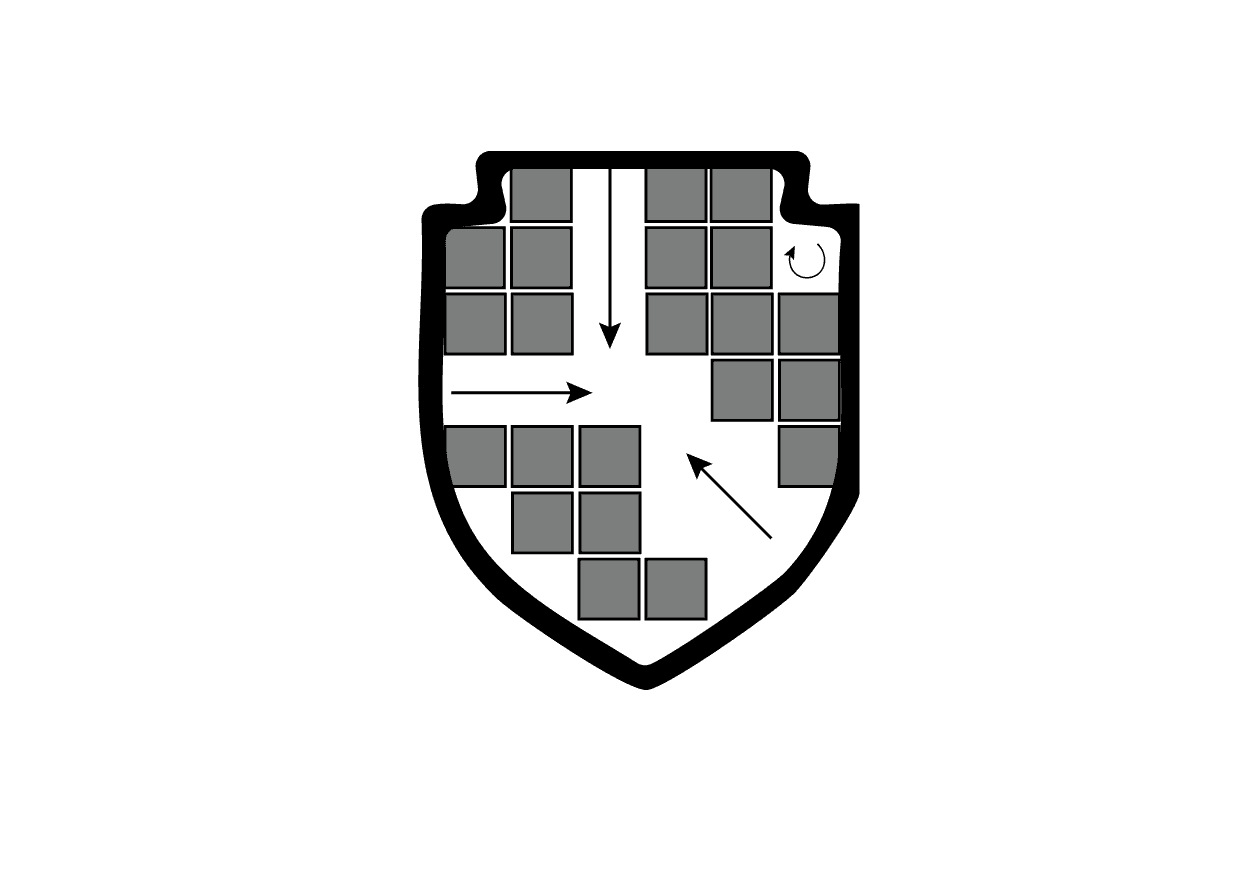
Those point clouds were extrapolated from the flat surface of the field into three dimensional coordinates. The two teams were networked together, their data points connected to form a structural mesh. That mesh was given direction. Each team's data rotated, organised and sorted into spatial zones. Public. Private. Shared. The system decided where each zone sat, how large it was, and how it connected to everything around it.
Each player generated a room. The goalkeeper became the main retail storefront and back of house storage, the single fixed point the whole building organises around. The full backs became staff and facility spaces. The central midfielders became circulation, the connective tissue running through the building, because that is exactly what they are on a pitch. The striker became the full indoor football court at the centre of everything. The substitutes became athlete recovery and public training zones, present and functional, called upon when needed.
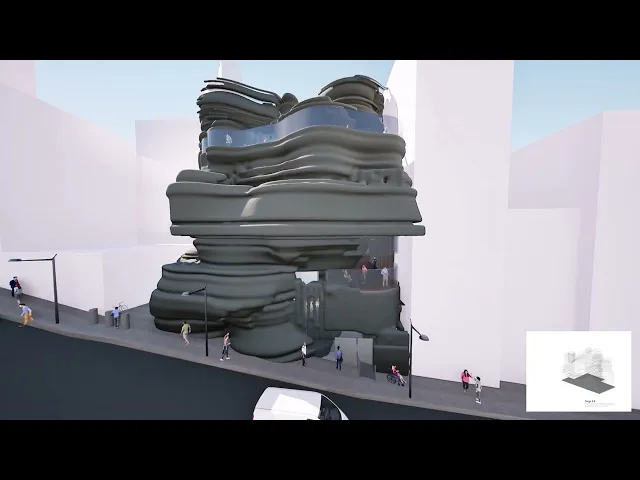
The surface came from the same place. Vector fields were built from the player position data, each line spaced according to where players actually stood and how they moved across the full match. The striated layered exterior you see is the field of play made physical. The building does not reference the game. It is the game, held in form and section.
Velocity Works starts with a real football match. Not as inspiration. As data.
Every player tracked. Every position, every touch on the ball, every pass, every goal, every minute on the pitch recorded from full match footage and converted into datasets. All 22 players. Substitutes included. Each player became a graph, then a plot, then a point cloud sitting in three dimensional space.
Those point clouds were extrapolated from the flat surface of the field into three dimensional coordinates. The two teams were networked together, their data points connected to form a structural mesh. That mesh was given direction. Each team's data rotated, organised and sorted into spatial zones. Public. Private. Shared. The system decided where each zone sat, how large it was, and how it connected to everything around it.
Each player generated a room. The goalkeeper became the main retail storefront and back of house storage, the single fixed point the whole building organises around. The full backs became staff and facility spaces. The central midfielders became circulation, the connective tissue running through the building, because that is exactly what they are on a pitch. The striker became the full indoor football court at the centre of everything. The substitutes became athlete recovery and public training zones, present and functional, called upon when needed.
The surface came from the same place. Vector fields were built from the player position data, each line spaced according to where players actually stood and how they moved across the full match. The striated layered exterior you see is the field of play made physical. The building does not reference the game. It is the game, held in form and section.

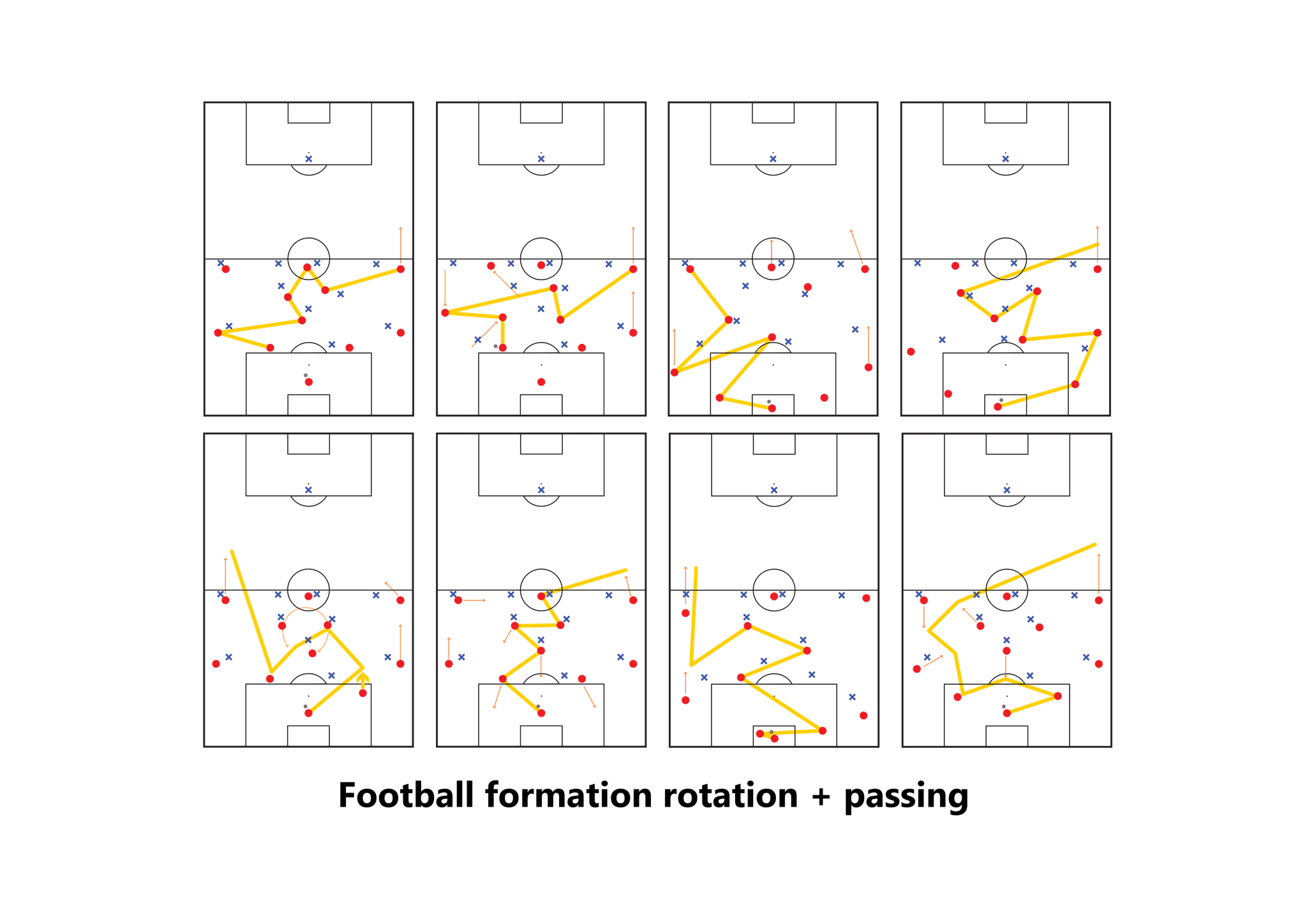
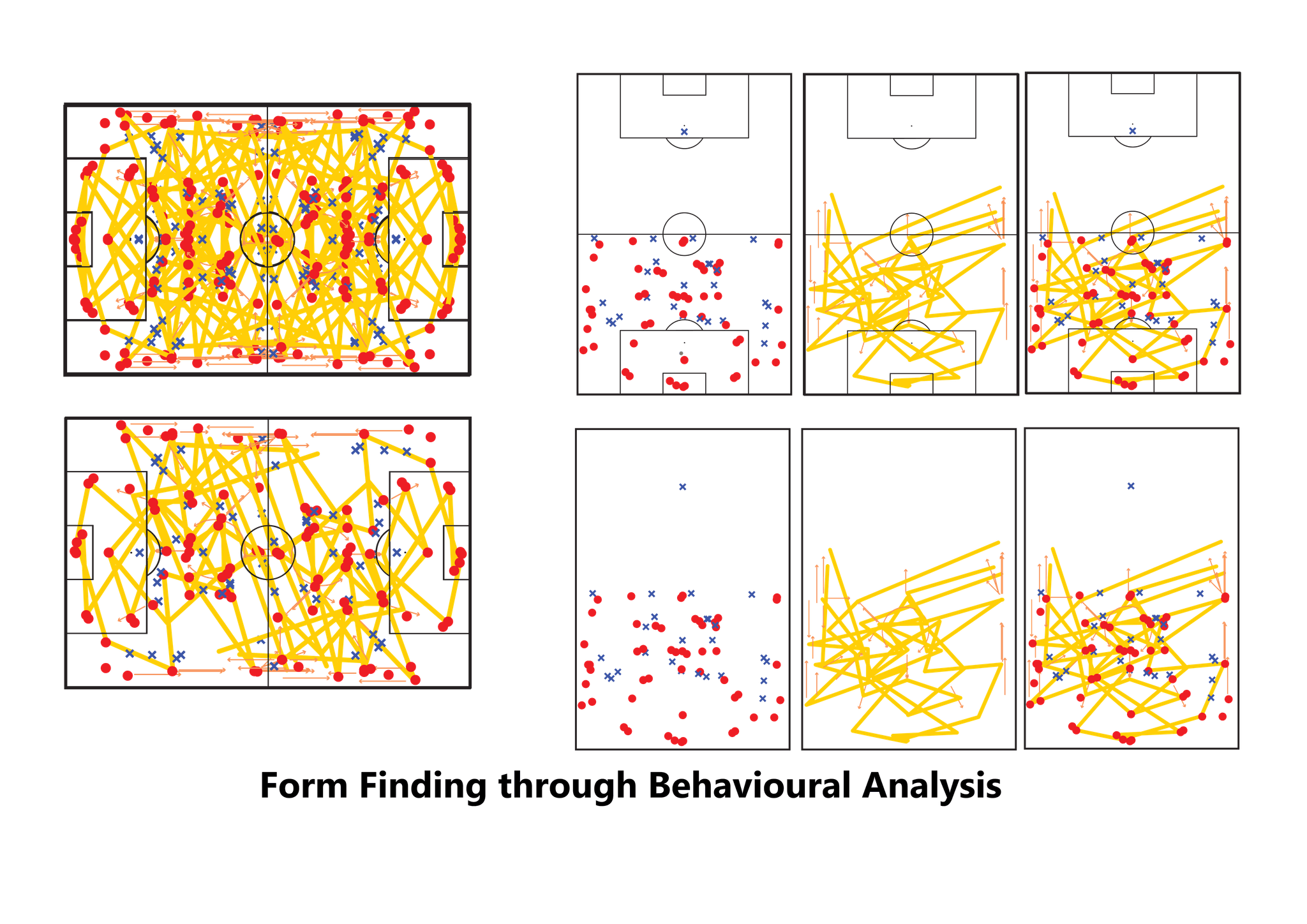
This project explores the analysis of player structure and process-based design through game analytics and statistical data visualization. By examining gameplay data, we generated graphs and designs that ultimately formed the blueprint for the building's architectural design.
Each component was built cohesively, with design chunks proportionally scaled to individual player roles and statistics in conjunction with their respective data profiles. The spatial arrangement of rooms is guided by the data fields generated from player activity, which are then contrasted with vector fields to inform the overall design language. This approach culminates in a spiral design motif that unifies the architecture throughout the building.
This project explores the analysis of player structure and process-based design through game analytics and statistical data visualization. By examining gameplay data, we generated graphs and designs that ultimately formed the blueprint for the building's architectural design.
Each component was built cohesively, with design chunks proportionally scaled to individual player roles and statistics in conjunction with their respective data profiles. The spatial arrangement of rooms is guided by the data fields generated from player activity, which are then contrasted with vector fields to inform the overall design language. This approach culminates in a spiral design motif that unifies the architecture throughout the building.
The Site
The building sits in the Bourke Street precinct of Melbourne CBD, on a block running between Elizabeth Street, Hardware Lane and Little Bourke Street. The site was chosen for what it does not have. Melbourne's inner city has no publicly accessible sports facility. Green space exists for leisure. Marvel Stadium operates privately. Nothing sits between the two.
Velocity Works occupies that gap. A co-working and sports facility embedded in the city, open to the public, generated from the field it houses.
The Programme
Five zones. Each one coming directly from the data.
Public. Retail, coffee shop and meeting rooms at street level. The part of the building that belongs to the city.
Athletics Centre. Training facilities, gym, athlete recovery and public pitch access. The working core for anyone who comes to play or train.
Staff Centre. Core office, design production, media and advertising team areas, campaign studio. The professional floors sitting above.
Soccer Pitch. Full indoor court at the spatial centre of the building. Generated directly from the striker's match data. The reason the building exists.
Meeting and Relaxing. Private viewing, breakout rooms and quiet floors where the building slows down and opens up.
Final Form
Final Form
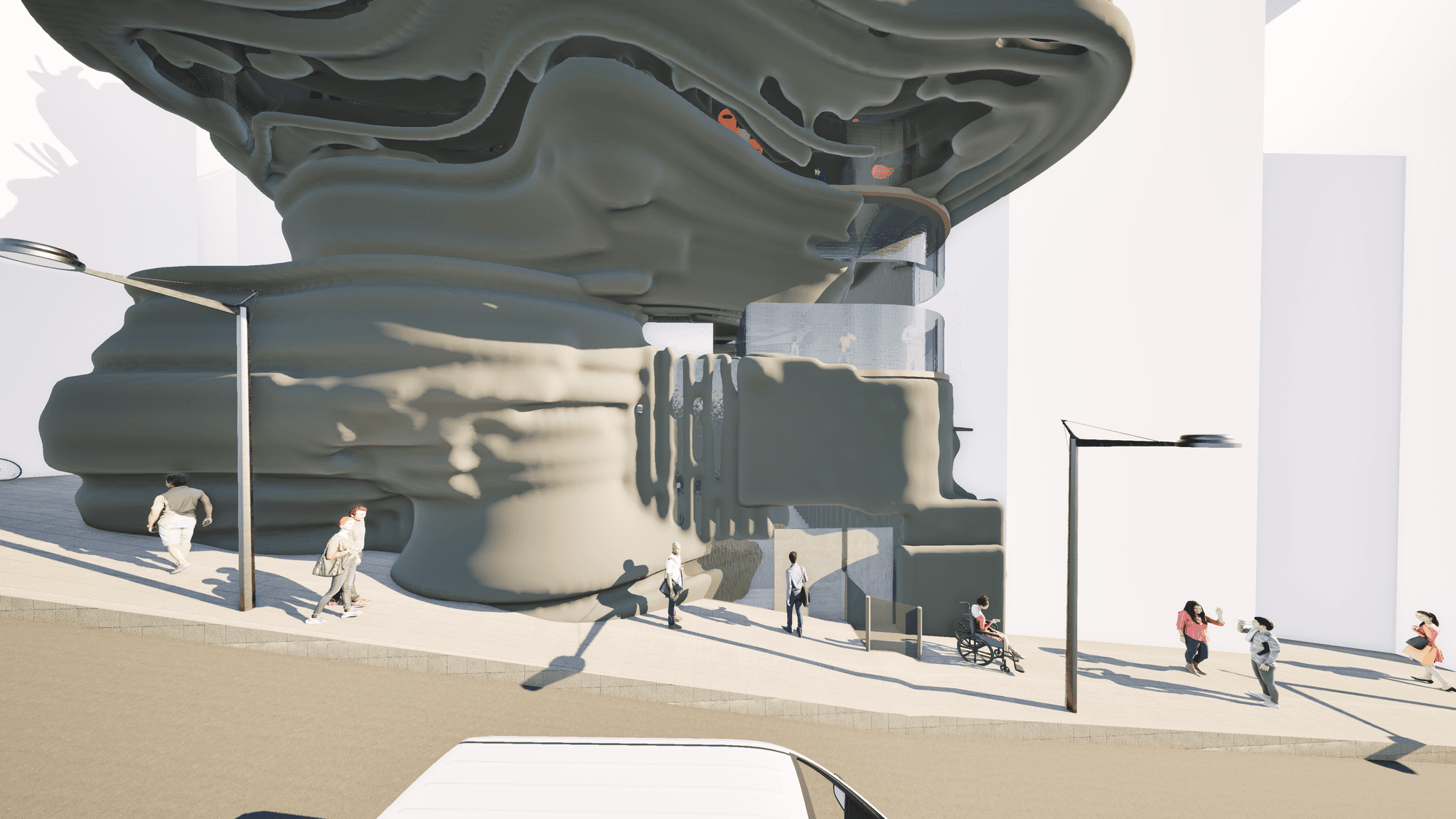
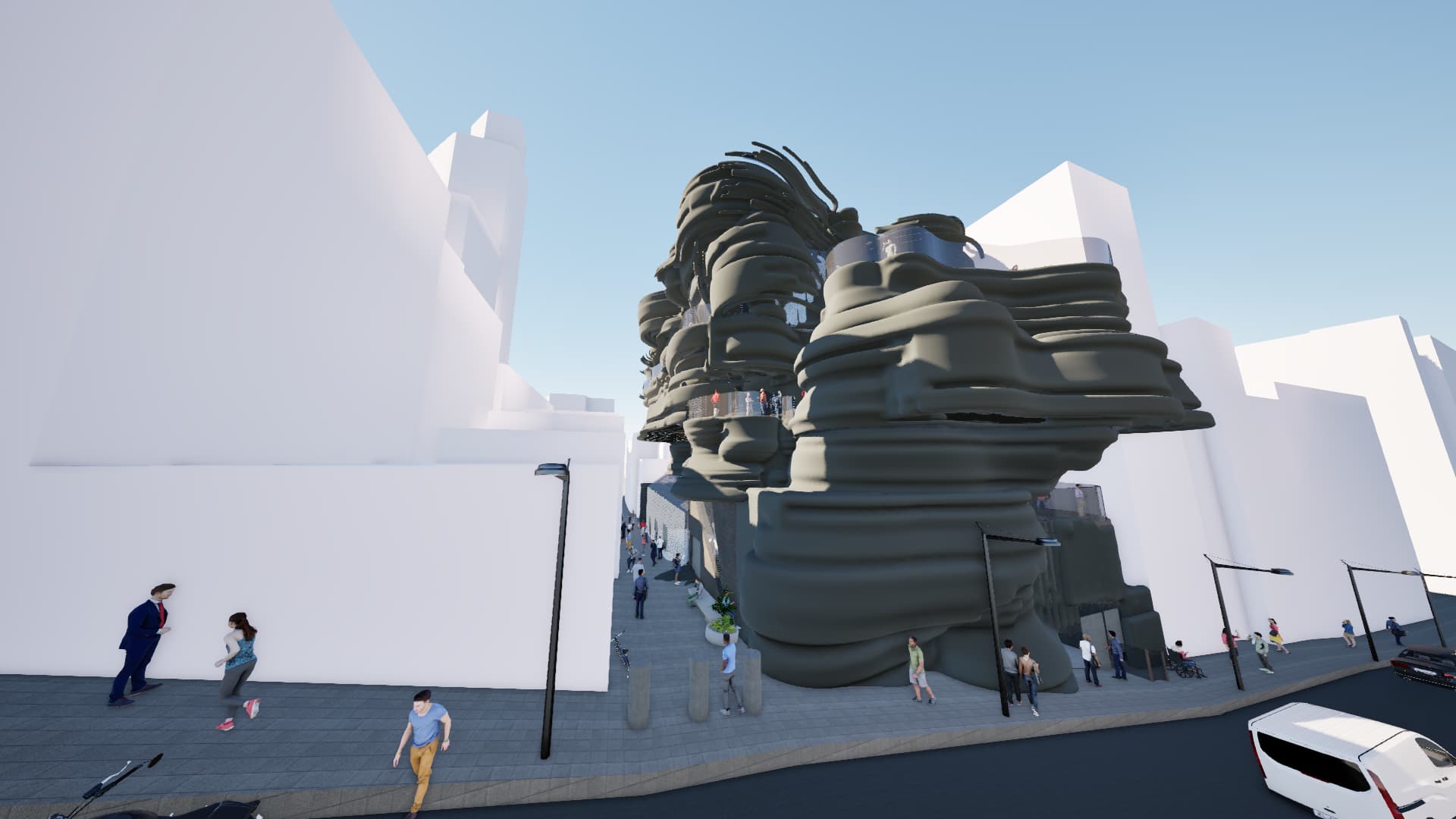
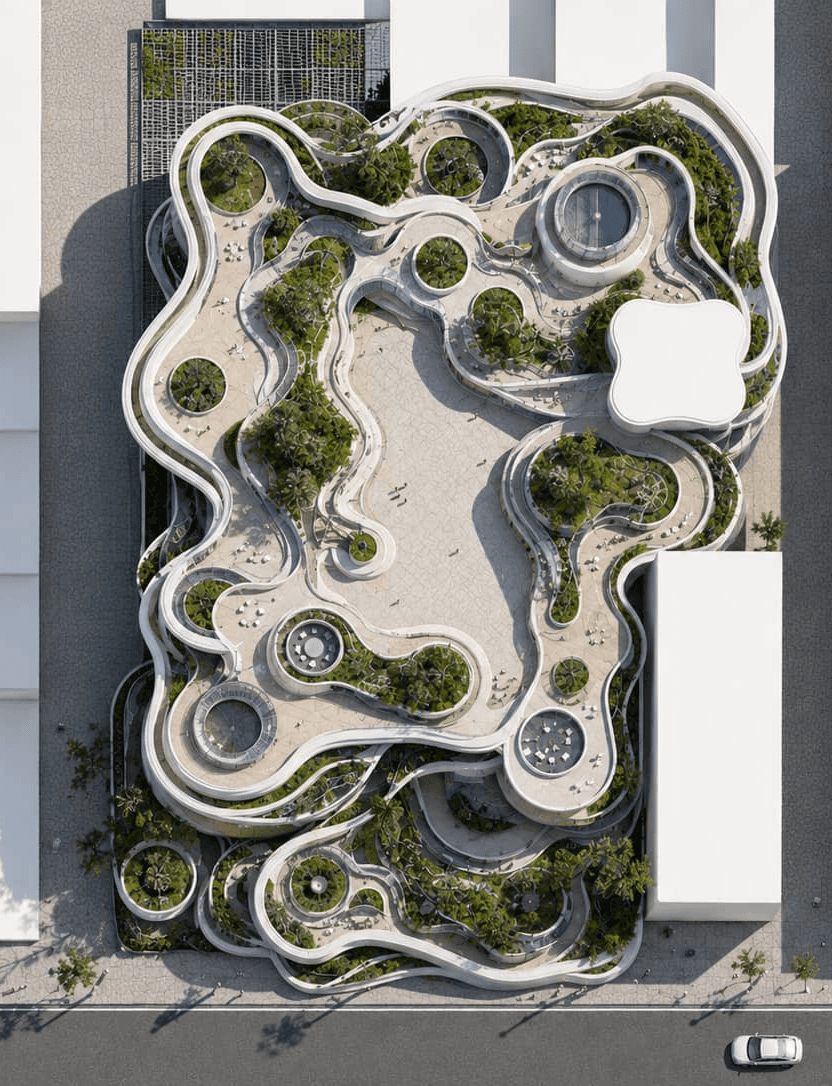
The final rebuild of Velocity Works transforms the project from a data-generated spatial experiment into a complete architectural proposal. The building is no longer treated as a fragment, a diagram, or a single rendered object. It now reads as a whole civic sports workplace, with a consistent massing language, a resolved street presence, a believable façade system and a clear architectural identity.
AI was used in this stage as a tool for refinement, helping translate the project’s earlier computational language into a more believable architectural proposal. The final image does not replace the original design process. It extends it, giving the project its completed form.
The final rebuild of Velocity Works transforms the project from a data-generated spatial experiment into a complete architectural proposal. The building is no longer treated as a fragment, a diagram, or a single rendered object. It now reads as a whole civic sports workplace, with a consistent massing language, a resolved street presence, a believable façade system and a clear architectural identity.
AI was used in this stage as a tool for refinement, helping translate the project’s earlier computational language into a more believable architectural proposal. The final image does not replace the original design process. It extends it, giving the project its completed form.




Film
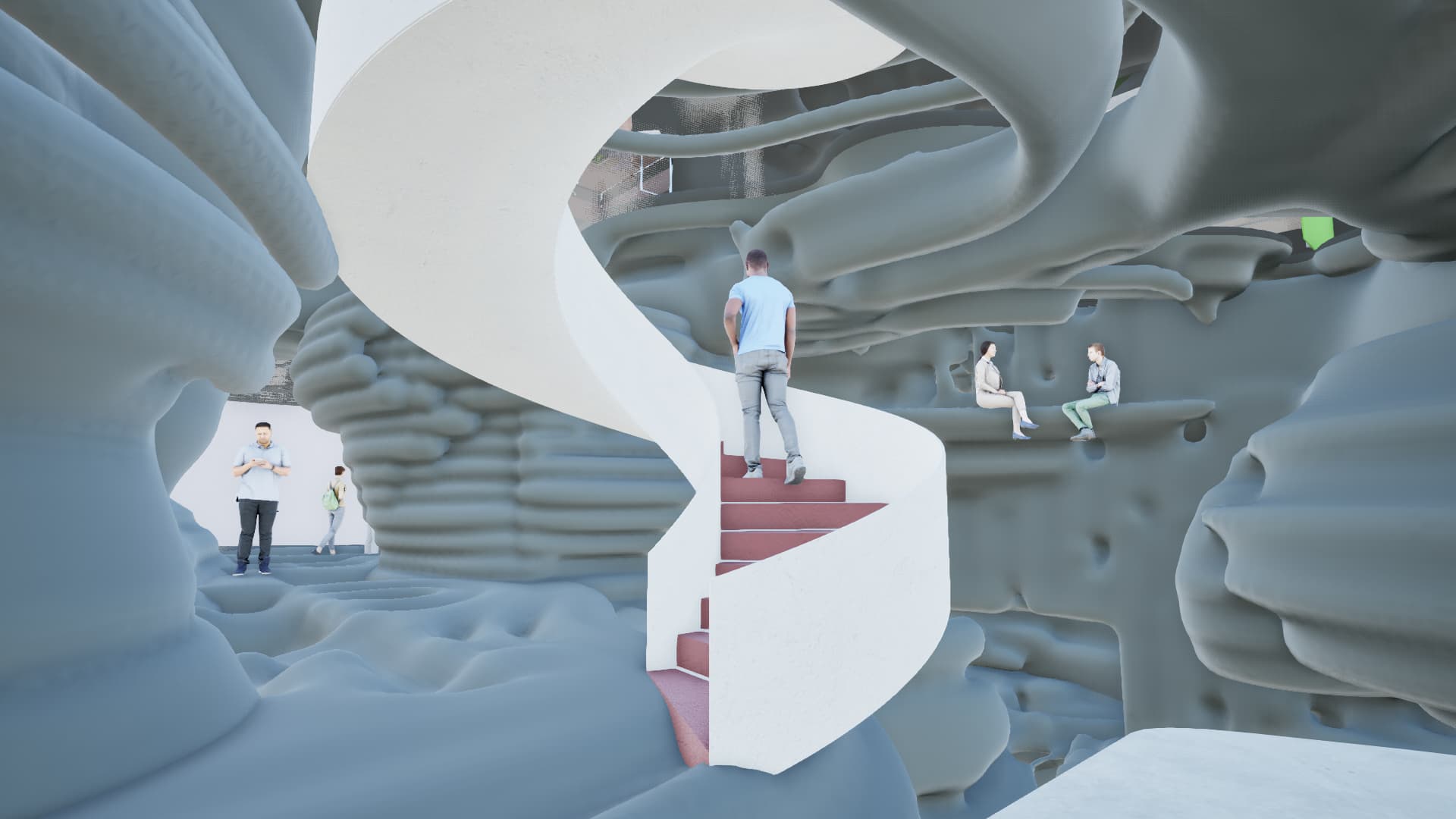
The film shows a fly-through of the spaces, with the overall intent of communicating movement, flow and spatial integration. It suggests that even before the moulding of defined spaces, the spatial system itself can begin to feel inhabitable.
The sequence in the bottom-right corner depicts the process behind the creation of the form. It shows how data can be translated into a building system, revealing the transition from abstract information into spatial, structural and dynamic architectural form.